
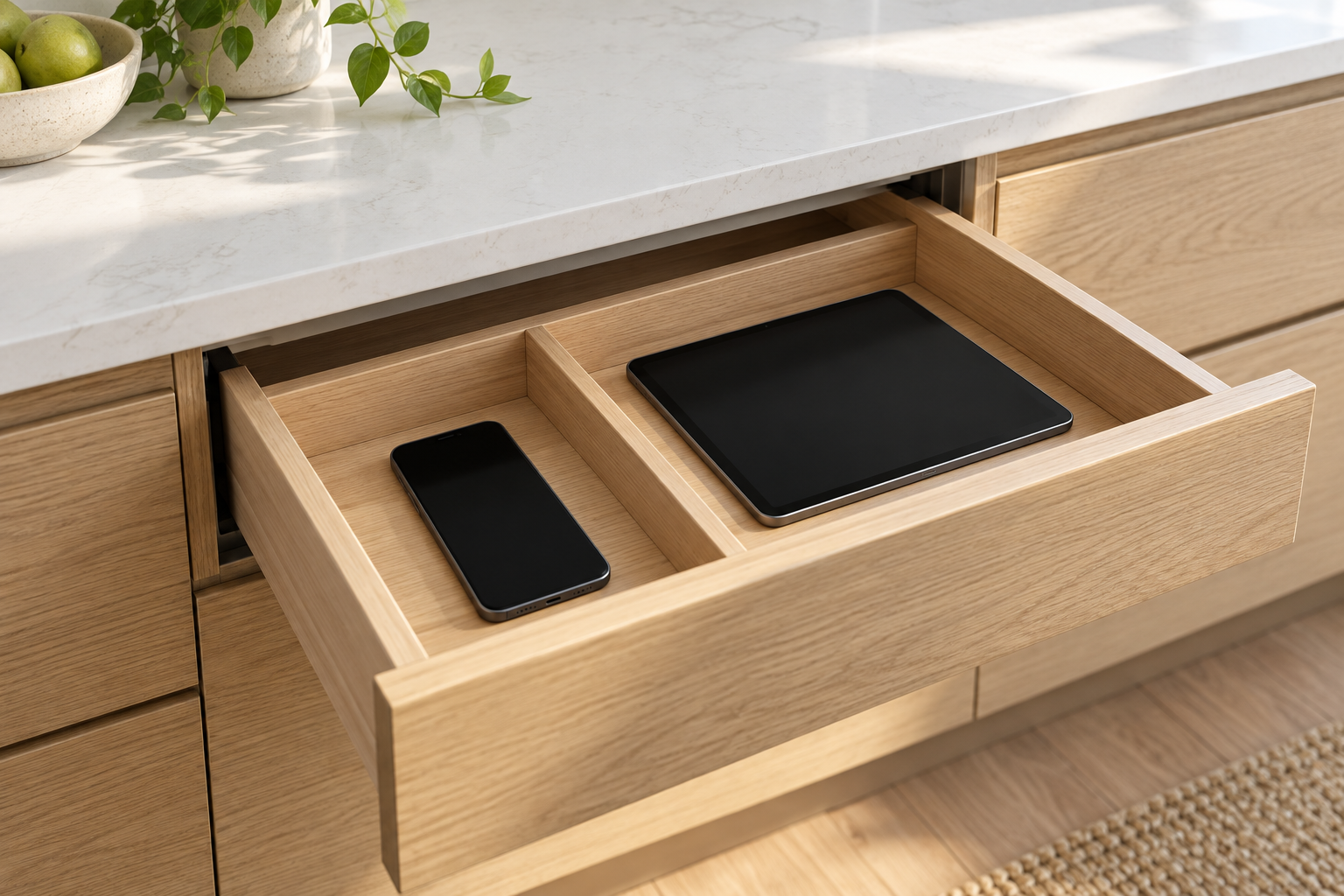
In-Drawer Outlets: How to Keep Phones and Tablets Charged Off the Counter
An in-drawer charging station gives phones and tablets a place to live without covering the kitchen counter. Plan the drawer, the devices and the power system together: a purpose-built drawer outlet needs room for its moving cable mechanism, and a kitchen island may need a different solution from a perimeter cabinet.
For this guide, a charging drawer means storage for personal electronics. It is not a place to run a toaster, kettle or other cooking appliance behind a closed drawer front.
Start with the devices you actually charge
Lay out the household’s phones and tablets, in their cases, on a piece of paper the size of the usable drawer bottom. Add the charging connectors and enough room to pick up each device without lifting another one. A tablet that fits diagonally may still be inconvenient to put away every day.
Choose a location near where devices accumulate, but outside the splash and food-preparation area. Avoid turning the utensil drawer beside the stove into a charging station just because it is available. Keep loose metal utensils, towels and food out of the charging space.
A shallow drawer can work well for phones. A large tablet or laptop changes the space and charging requirements. Check the device manufacturer’s charging and ventilation instructions; do not cover charging devices or adapters with liners or stacks of paper.
What should you measure before ordering?
Measure the drawer box itself, not just the decorative front. Record its outside width, inside height, depth and the gap between its back and the cabinet back. Photograph the slides, rear brackets and anything else that occupies the moving mechanism’s path.
Then check the selected product’s installation drawing. Drawer systems are not interchangeable. Docking Drawer’s current 15-amp Blade Duo planning information, for example, distinguishes shallow and tall drawers and specifies rear clearance for its cable-management arms. Those dimensions apply to that system, not to every charging drawer.
Ask the cabinetmaker to check the entire travel of the drawer, including the fully closed position. A cable that looks loose enough with the drawer open can be pinched when it closes. Do not cut the drawer until the exact model, mounting orientation and required clearances are confirmed.
USB-only or ordinary AC receptacles?
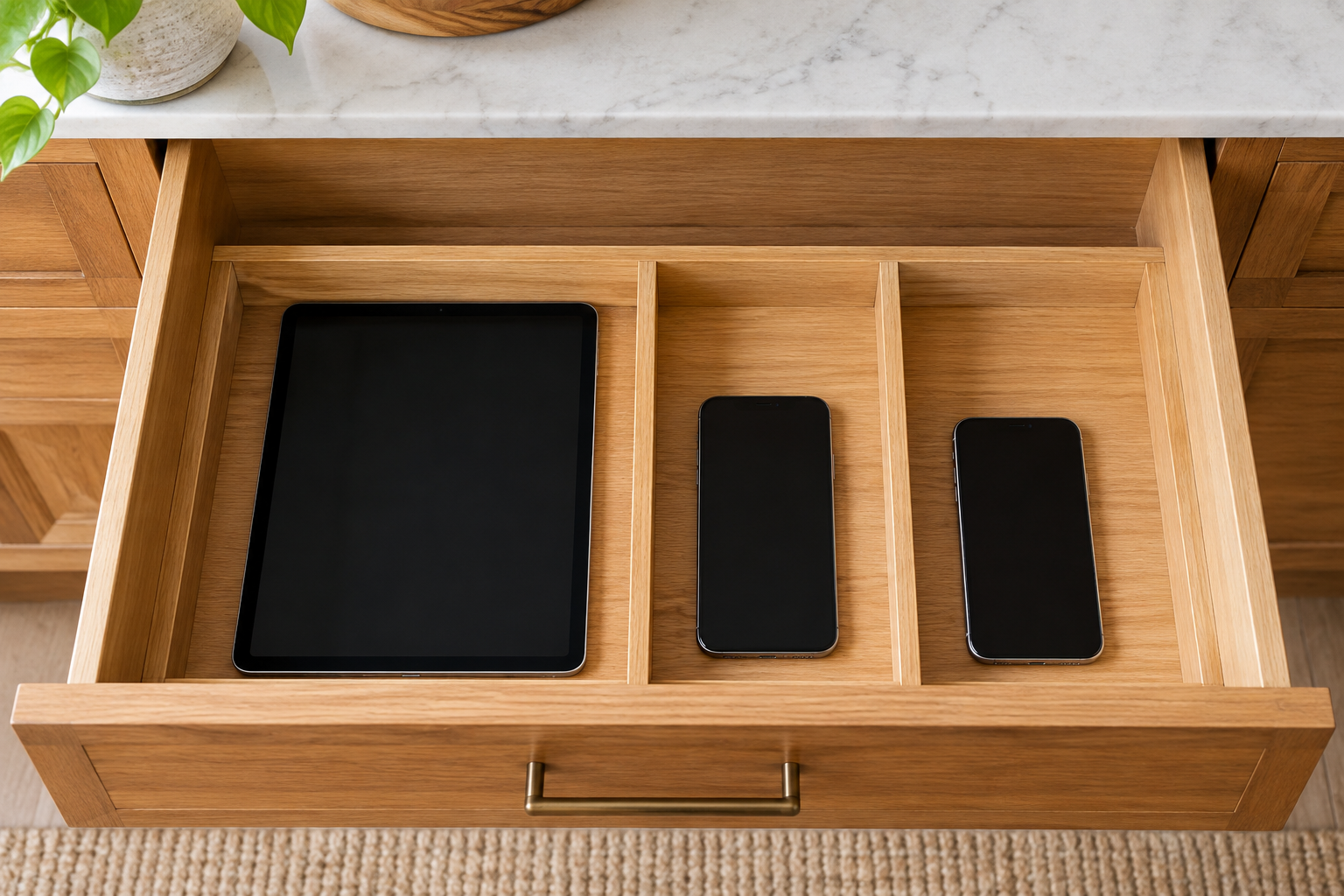
A USB-only configuration can be useful when the goal is simply charging compatible phones and tablets. It also avoids filling the drawer with plug-in power adapters. Check connector types, supported charging protocols and shared output: the largest wattage printed on a product page may not be available at every port simultaneously.
An AC receptacle accepts a device’s separate charger, but introduces another object and its heat into the drawer. It does not make the drawer suitable for every plug-in appliance. Choose the configuration for a defined use rather than the greatest possible number of sockets.
The distinction matters particularly in kitchen islands and peninsulas. Docking Drawer’s published guidance for the 2023 NEC distinguishes USB-only configurations from AC-receptacle configurations in those locations. Treat that as a reason to have the exact location and product checked against the locally adopted rules, not as a nationwide approval.
Electrical guidance reviewed by Lavender Electric LLC
Lavender Electric LLC reviewed the electrical-planning questions below for My Recipes Haven. The licensed Seattle-area electrical contractor works on residential kitchen circuits and receptacle upgrades, including the fixed electrical supply a cabinet charging system needs. Thank you to Lavender for reviewing the electrical considerations. Product fit, port output and listing information come from the manufacturer.
Can you put an outlet inside a kitchen drawer?
Purpose-built systems exist, but the answer depends on the product and drawer location. A moving drawer needs a system intended for that use, with the required cable management and a suitable supply connection. Do not improvise by trapping a loose power strip or extension cord behind the drawer.
Does a charging drawer replace required countertop outlets?
Do not count a hidden drawer connection as a replacement for required countertop receptacles without your electrician’s confirmation. The requirements for serving a work surface and the requirements for powering a drawer system are separate planning questions.
Where does the supply receptacle go?
Place it according to the selected system’s instructions, with the electrician and cabinetmaker checking plug clearance, cord reach, drawer movement and future access. Its location should be settled before cabinetry blocks the route. Leave enough access to disconnect and service the system without damaging the cabinet.
What about GFCI and AFCI protection?
Have the electrician determine the required protection for the location and circuit under the adopted code. A product’s temperature shutoff is not the same thing as GFCI or AFCI protection. Nor does adding more USB ports increase the capacity of the branch circuit supplying them.
Products worth comparing
The Docking Drawer Blade Duo 1514-278 is one manufacturer-listed configuration combining USB and AC connections. Compare it with the USB-only Blade Duo 1514-288 when planning a devices-only drawer, particularly an island or peninsula. Both are identified in the manufacturer’s Blade Duo configuration guide; confirm the exact order selection and current installation documents before buying. These are planning examples, not a claim that either fits your cabinet or has been hands-on tested by My Recipes Haven.
If your real goal is hiding countertop cooking equipment, start with our appliance garage planning guide. An appliance garage and a charging drawer solve different problems.
Take these decisions to the cabinet meeting
- Which devices, cases, connectors and chargers must fit?
- Is the drawer in a perimeter cabinet, island or peninsula?
- Which exact system and charging configuration is proposed?
- Does the installation drawing fit the drawer and its full moving path?
- Where will the electrician put the supply connection, and how will it be accessed?
Electrical codes, product requirements and local rules can change and vary by jurisdiction. Consult a qualified electrician and verify the currently adopted electrical code, local requirements and manufacturer instructions before making electrical changes.
Some images on this page were created with AI for illustrative purposes.